
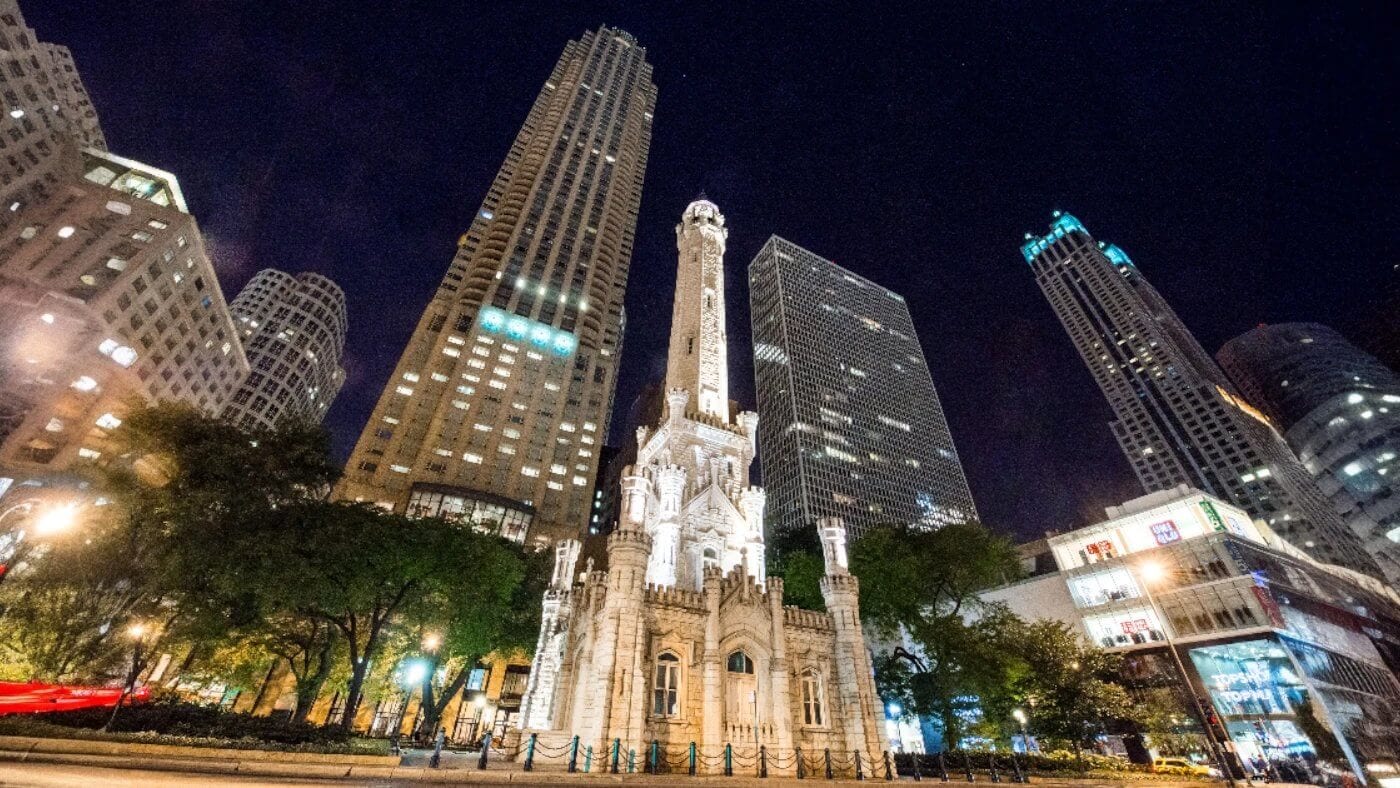
WATER Tower Style: The 5 Coolest WATER TOWERS on Earth

Table of Contents
- Scotty McCreery sings about 'em. You see them over treetops in small towns and towering over city streets. They are shrines to h2o. We’re talkin' water towers ...
- 1 - The Water Survivor - Chicago Water Tower, Illinois, USA (1869)
- 2 - The Beautiful Water Ghost - The Krestovsky Moscow Water Towers, Moscow, Russia (1892 - 1939)
- 3 - The Peachy Audacity Of Water - The Peachoid Water Tower, Gaffney, South Carolina, USA (1981)
- Three Peachy Fun Facts
- 4 - Oasis In The Desert - The Kuwait Towers, Kuwait City Kuwait
- Three Kuwait Tower Fun Facts
- 5 - Fairytale Water Genius - The House in the Clouds Water Tower, Thorpeness, Suffolk, England
- What These Towers Share
- A Deeper Look At The Issue - Video
Scotty McCreery sings about 'em. You see them over treetops in small towns and towering over city streets. They are shrines to h2o. We’re talkin' water towers ...
She almost didn't notice it. Maria Hernandez, a Chicago landscape architect who has spent fifteen years designing public parks, told me she walked past the Chicago Water Tower every morning for three years before she actually stopped and said ...
"I was always looking at the buildings around it," she said. "The glass, the steel. The tower just sat there. And then one day I looked at it — really looked — and I thought: what happened here? Why does this thing look like a castle?"What happened, it turns out, is a story that repeats itself on every inhabited continent.
Again and again, in cities from Chicago, IL, Kuwait City, Kuwait to Suffolk, UK to Gaffney, SC engineers faced a problem that was purely functional, to store water up high so gravity can push it down and somewhere between the drawing board and the construction site, something else crept in. Pride. Politics. Art. The insistence that a tank of water could also mean something.
The five towers that follow were built to do a job. They ended up telling the truth about the culture and the places that built them.
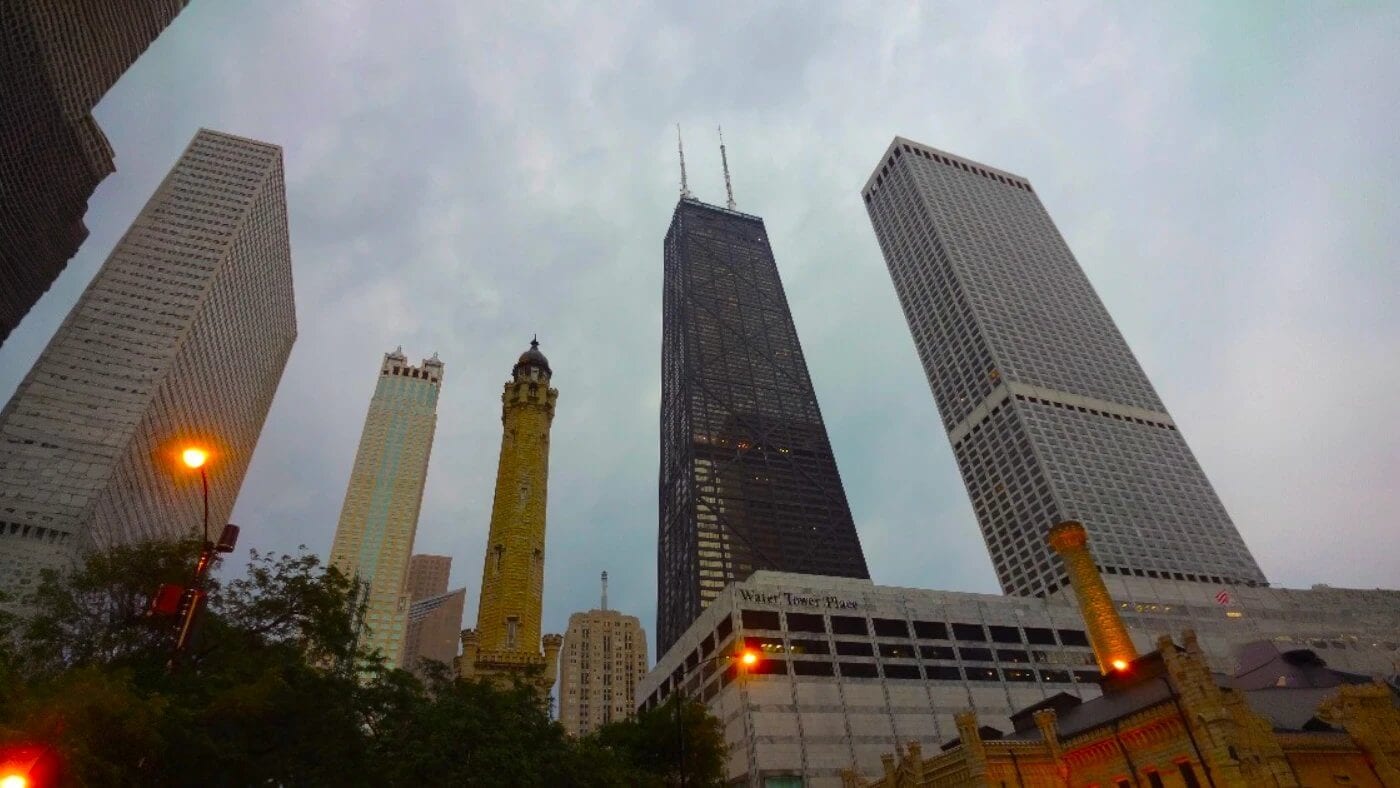 The Chicago Water Tower, 1869. The tower among towers / Image Credit Wikimedia Commons
1 - The Water Survivor - Chicago Water Tower, Illinois, USA (1869)
The fire came on a Sunday night in October 1871, driven by southwest winds across a city that was mostly wood. Three and a half square miles of Chicago burned to ash. Roughly 100,000 people were left homeless. Across the ruins, one structure stood almost entirely unscathed: a 154-foot tower of yellow Joliet limestone, battlemented and turreted like something a Victorian child had imagined a castle should look like.
The Chicago Water Tower is the only municipal building to have survived the Great Chicago Fire of 1871, making it a symbol of resilience for the Chicagoan spirit. Its survival was not accidental — architect William Boyington built it with almost no wood, and a German immigrant fireman named Frank Trautman protected both the tower and the adjacent pumping station by covering them with wet woolen blankets and discarded canvas sails.
Inside, the tower housed a 138-foot vertical iron standpipe, purely a hydraulic pressure equaliser. It didn't need to look like a castle. But the city decided it should, and the purpose of the long toil in its limestone stonework lay solely on the aesthetic level. After the fire, that aesthetic decision became a civic one. The tower became the first landmark survivors navigated toward. It came to symbolise Chicago's "I Will" spirit before anyone had coined the phrase.
That instinct — to make infrastructure mean more than it has to — is the thread that runs through every tower on this list.
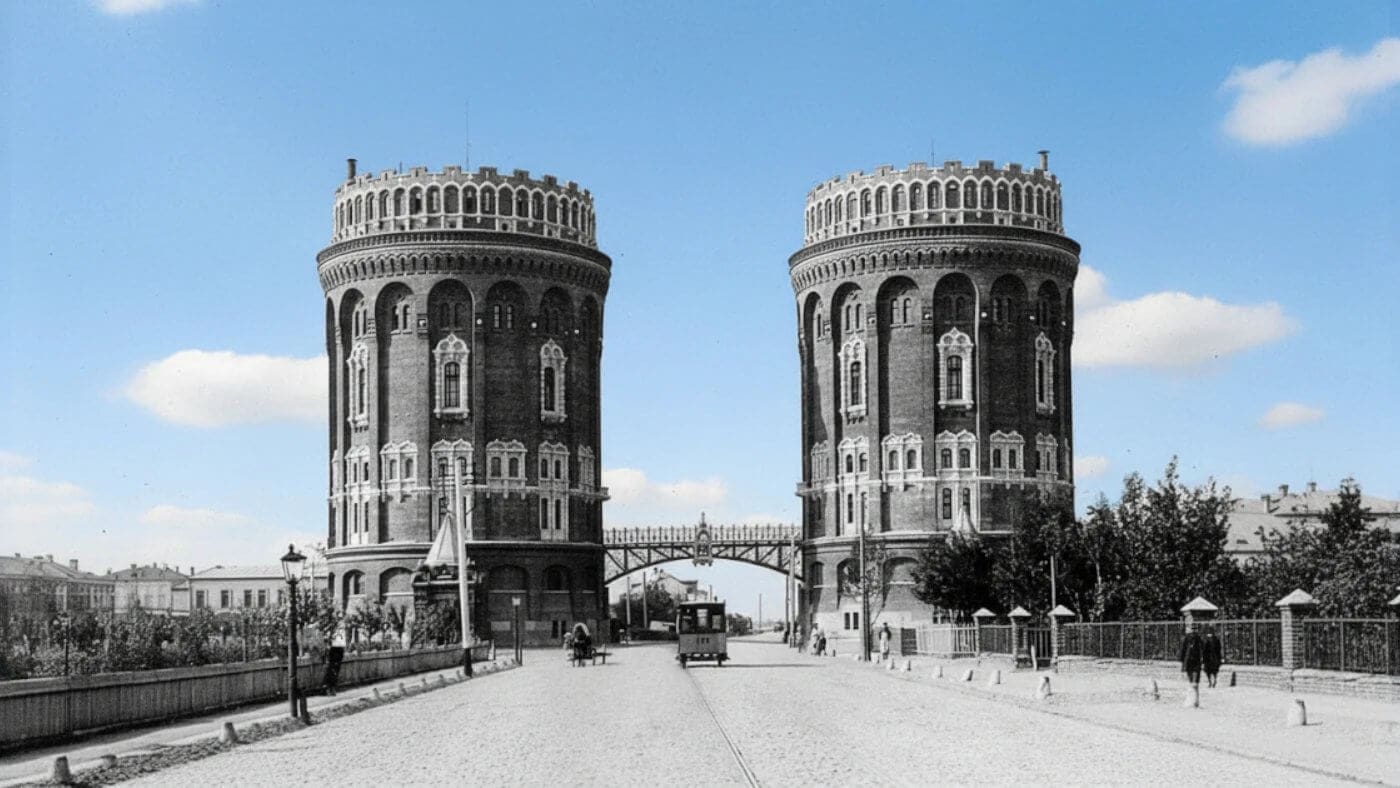 Krestovsky Neo-Russian Style Moscow Water Towers, designed by architect Maxim Geppener in 1892 and demolished in 1939-1940 to make way for the Yaroslavl Highway/ Image Credit Wikimedia Commons
 2 - The Beautiful Water Ghost - The Krestovsky Moscow Water Towers, Moscow, Russia (1892 - 1939)
Most of the water towers on this list still stand. Moscow's Krestovsky towers do not — and that absence is part of what makes them worth knowing.
The Krestovsky Neo-Russian Style Moscow Water Towers, designed by architect Maxim Geppener in 1892 and demolished in 1939-1940 to make way for the expansion of the Yaroslavl Highway.
In 1892, two 40-metre Krestovsky water towers were built during the reconstruction of the Mytishchi water pipeline at the beginning of the Yaroslavl Highway. The Mytishchi pipeline itself was a feat of imperial ambition — a gravity-fed conduit from freshwater springs north of Moscow, originally commissioned by Catherine the Great and expanded over three reigns. By the late 19th century, a rapidly industrialising city had outgrown it. The towers were the elegant answer.
They were not only a practical solution; they were the decoration of the city. In 1896, one tower became home to the Museum of the Moscow City Economy, forerunner of the modern Museum of Moscow.
In 2018, belatedly mourning the destruction of the Krestovsky water towers in 1939, Oksana Bozhneva, Head of the Water Museum of Moscow Waterworks said ...
"These buildings looked just amazing, and unfortunately, they were torn down in 1939 during the renovation of the motorway."Personally, if I walked through the streets of Moscow in the late 1800s, (and I did not) I might have thought I had stumbled into two turrets on a palace - looking like huge rooks in game of chess. Quite a cool design for water vessels serving up H2O for the Moscovites of the time.
WaterCheck CityCheck Deluxe Water Test Kit Premium 115 Contaminant Analysis With Pesticides, Herbicides And PCBs
$329.00
Get peace of mind in every drop. Stop guessing what's in your water and start knowing. With our WaterCheck CityCheck Deluxe Lab Test Kit Premium… read more

Then, in late 2022, the Museum of Moscow erected ice sculptures of legendary Moscow buildings in its courtyard — among them the incredible Krestovsky towers. As soon as the ice melted, the sculptures disappeared. It was, unintentionally, the most honest memorial a demolished building could receive: a temporary resurrection that the weather would erase. Maria went quiet when I described this. And she shared ...
"When it goes, it really goes. Nobody builds a monument to a water tower. Except apparently they did. In ice."Next up, let's move to the giant Peach water tower, called The Peachoid in the American South. The Peachoid transforms boring h2o infrastructure into bold, fruity fun.
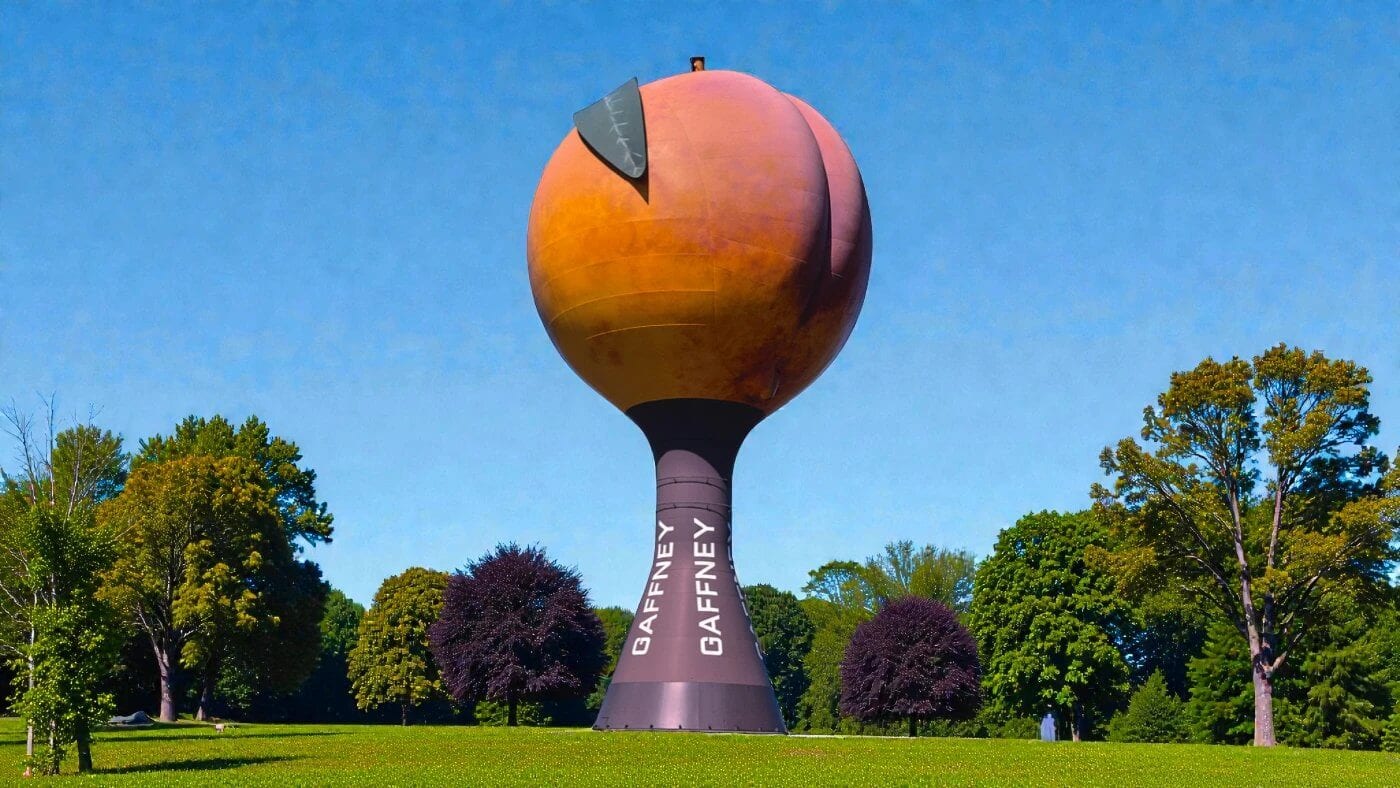 Peachoid, Pear Shaped Water Tower, Gaffney, SC, USA / Credit John Margolies, Library Of Congress
3 - The Peachy Audacity Of Water - The Peachoid Water Tower, Gaffney, South Carolina, USA (1981)
If you’ve ever driven down I-85 in South Carolina, you’ve probably done a double-take. Rising 135 feet into the air is a giant, 1-million-gallon peach. Known as The Peachoid, this tower was built in 1981 to celebrate the local peach farmers and the water it takes to grow those awesome peaches.
What makes it cool isn't just the size—it’s the detail. The artist used 50 gallons of paint in 20 different colors to make it look like a real piece of fruit, complete with a giant leaf and a cleft (the line down the middle of a peach). It’s a perfect example of how a community can take something necessary and make it a local legend. It was built by the Chicago Bridge and Iron Company.
The Peachoid Water Tower was built after a Board of Public Works member named Jack Millwood, who had long dreamed of a landmark for passing I-85 drivers. Jack found his opportunity when a 1978 engineering study revealed the county needed a new water tank for pressure and fire protection. Jack said ...
"Let's build it in the shape of a peach," he said, without irony.
The choice was agricultural advocacy in steel and paint. South Carolina, and at one time Cherokee County alone, produced more peaches per year than the entire state of Georgia — which is known as the Peach State. The Peachoid is, among other things, a 135-foot counter-argument. After the crew initially painted it yellow with a brown stem and the jokes about its shape began, New Jersey artist Peter Freudenberg was commissioned to repaint it, studying local peaches for hours and using fifty gallons of paint in twenty colours. The result won the 1981 Steel Tank of the Year award from the Steel Plate Fabricators Association.
According to official literature, the Peachoid stands boldly in its peachiness ...
"Sets the record straight about which state is the biggest peach producer in the South. Contrary to popular belief, it is not Georgia."
Three Peachy Fun Facts
- A Million Watery Gallons Of Fruity Joy: The Peachoid isn’t just roadside art, it’s a fully functional water tower holding one million gallons. That’s the kind of bold, joyful infrastructure WaterCelebration lives for: water doing its job while making people smile.
- The Peachoid Had A Big Butt Problem Before Becoming Famous: The original paint job by Chicago Bridge and Iron Company looked so awkward - people joked that it resembled a giant backside. Then painter Peter Freudenberg was commissioned make it look more peach-like.
- Netflix Made It Iconic: The structure got national attention when it appeared in the Netflix series House of Cards, turning a roadside water tower into a pop-culture landmark.
Now, water geeks, onward we go to the Middle Eastern country of Kuwait and their world famous Kuwait Towers (aka Abraj Al-Kuwait)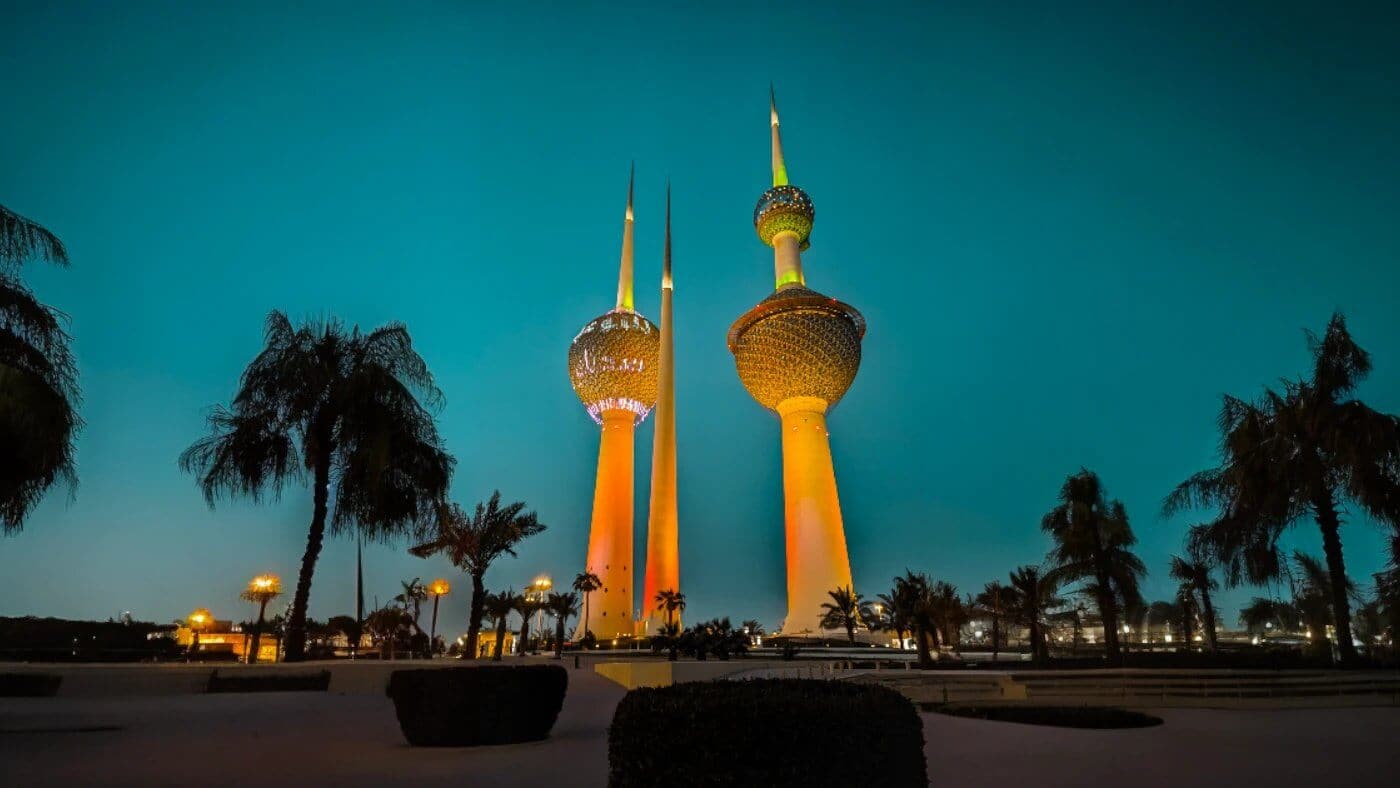
4 - Oasis In The Desert - The Kuwait Towers, Kuwait City Kuwait
In Kuwait, a country where water is more precious than oil, the decision to build a water tower that looks like a rocket ship aimed at the moon is either audacious or inevitable — depending on how you look at it.
Winner or the Aga Khan Award for Islamic Architecture in 1980, the Kuwait Towers have both emotional and architectural sophisticatation for water infrastructure. Plus, they’re beautiful, especially at night.
Completed in 1979 in Kuwait City, the project features three distinct towers crowned with spheres inspired by Islamic domes, blending regional aesthetics with modern engineering as part of a forward-looking municipal water distribution system.
What makes them special is design, intention and drawing from cultural heritage. According to The Kuwait Times article from Feb 21, 2026 ...
"The architectural design draws inspiration from traditional Kuwaiti heritage. The main tower symbolizes the incense burner (mabkhara), the middle tower represents the sprinkler (marash), and the smallest tower evokes the kohl container (mekhala), blending cultural symbolism with modern engineering. In recognition of its architectural significance, the complex received the prestigious Aga Khan Award for Islamic Architecture in 1980."
The tallest rising to 187 metres, each studded with spheres clad in enamelled steel tiles. They were the sixth, and final, group in the larger Kuwait Water Towers system of 33 mushroom shaped water towers. Inspired by Kuwaiti heritage, the main tower symbolises an incense burner; the middle, a water sprinkler; the smallest, a kohl container.
Three Kuwait Tower Fun Facts
- Food And Water Combo: In the main tower you can eat in a restaurant that literally sits above a giant water tank (4,500 m³!).
- Battle Scars: The towers were partially damaged during the 1990 invasion by Iraq but later restored, proving that water infrastructure can recover too.
- Design Plot Twist: Architect Malene Bjørn created the iconic look after Kuwait’s leader Sheikh Jaber Al-Ahmed wanted something more beautiful than earlier “mushroom” towers by Sune Lindström at VBB (now Sweco).
For water lovers and architectural geeks, the message is clear: when we celebrate water systems instead of hiding them, we strengthen our connection to the most essential element of life. The Kuwait Towers towers hold water, and they hold meaning, for people in the region and are they a magnet for water loving people from around the world.
Next up, on to the seaside fishing village of Thorpness, in Suffolk, England and the water tower that literally looks like a really tall house, aptly named House in the Clouds.
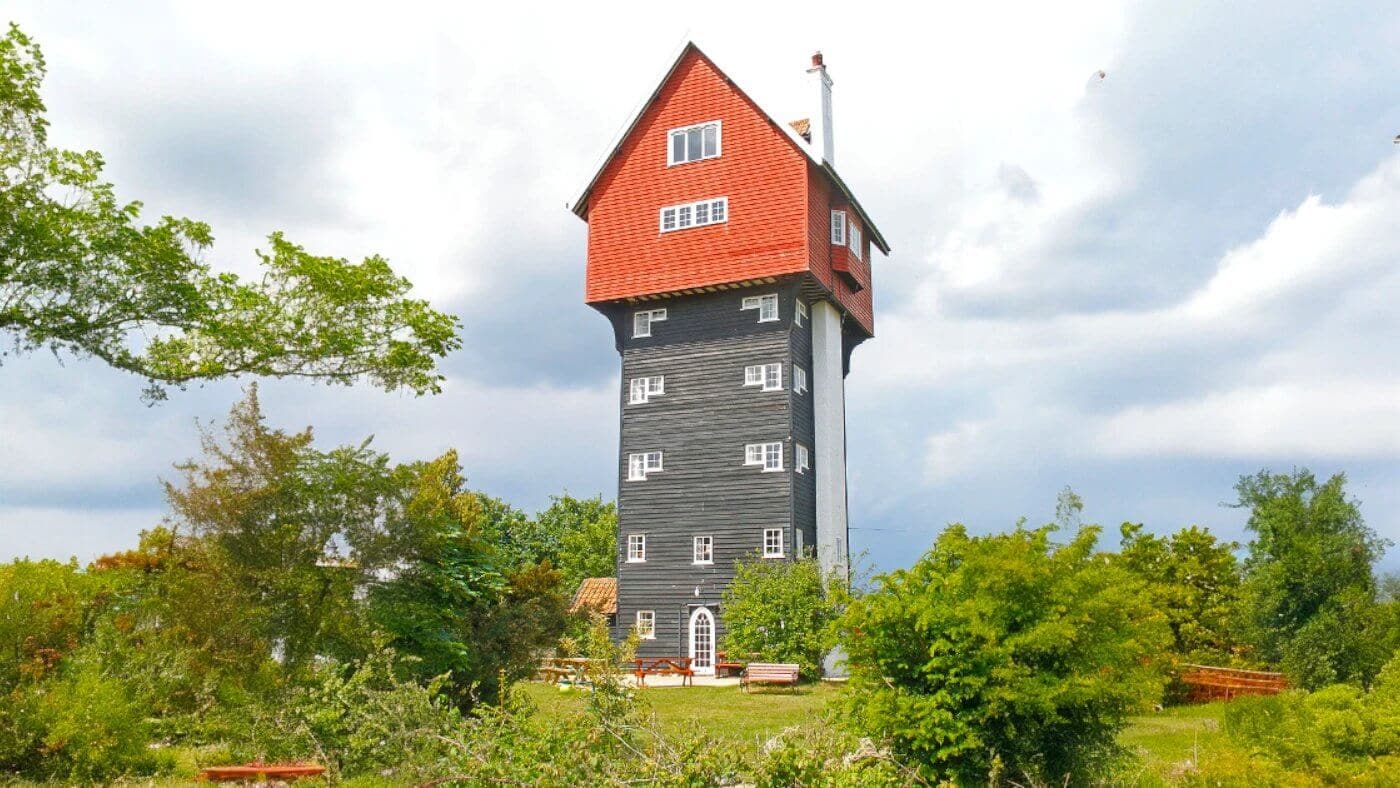 House in the Clouds Water Tower, Thorpeness, Suffolk, England / Credit Wikimedia Commons Rod Jones
5 - Fairytale Water Genius - The House in the Clouds Water Tower, Thorpeness, Suffolk, England
Floating high above the village of Thorpeness in Suffolk, The House in the Clouds is one of the world’s most whimsical examples of water engineering in hiding. in an well executed effort to work alongside the village's fairytale culture, the tank was encased in a house, perched atop a narrow five-story tower.
Built in 1923, it was originally designed to solve a purely practical problem: hiding an unsightly 50,000-gallon steel water tank that marred the skyline of the picturesque seaside resort.
Glencairn Stuart Ogilvie's problem in 1923 was simple: he had finished building a fantasy holiday village on the Suffolk coast and the local engineers told him the village needed a water tower.
With incredible attention to the fairytale theme of a village, Ogilvie brilliantly disguised the water tower as an illusion of a house that just experienced a massive growth spurt, or as the British would understand, a Jack and The Beanstalk moment.
The house was designed in particular for Mrs. Malcolm Mason, a writer of children's books and a close friend of Ogilvie’s. According to Mrs Mason ...
“The fairies really own this house or so the children say. In fact, they all of them moved in upon the self same day.”
During World War II, the building was accidentally hit by anti-aircraft gunfire from a nearby base. The tank was repaired using its own steel — reducing capacity to 30,000 gallons — and the house kept standing. In 1977, when mains water arrived in Thorpeness, the tank was decommissioned and the building became a private residence.
Today the House in the Clouds it is a water related vacation rental: five bedrooms, 67 stairs from the ground, and a tank where the top floor used to be. You can actually sleep inside what was once a water tower.
What These Towers Share
Five water towers. Five countries. One century of construction, from 1869 to 1981. What runs through all of them is more than water, it is the insistence that a purely functional object could be asked to do more work than its specifications required.
The Chicago Water Tower was asked to be a symbol of survival. The Krestovsky towers were asked to be beautiful, hosted a museum, and were erased by a road study — surviving now only in ice and archival photographs. The Kuwait Towers were asked to carry the weight of national identity and, later, national recovery. The House in the Clouds was asked to disappear, and in disappearing became unforgettable. The Peachoid was asked to hold water and ended up holding the civic peach pride of an entire county.
And still, Maria Hernandez walks past the Chicago Water Tower and says ...
"Every time I see it, I think about whoever decided to make it look like a castle. They didn't have to do that. And they did it anyway. That's what cities are, really. A series of decisions to do a little more than you really had to."
The towers agree.
A Deeper Look At The Issue - Video
Watch Kendra Gaylord's deep geeky dive into water towers: The impossible water tower beauty standards. Why, how, where ... Why again? Today we dive into why water towers exist and how they’ve changed over the past 150 years. I go ON LOCATION to Volunteer Park and walk up a water tower to better understand what is happening and why this brick building was designed for looks in 1906.
Related Articles
The HEALING WATER We Lost: The Ancient Science of Balneotherapy
Marta Kovács is 61 years old, a retired school administrator from Budapest, and she has been going...

The Miracle of Water Birth: A Gentle, Natural Approach to Childbirth
The tub was just a tub, white fiberglass, warm water, a handheld showerhead propped against the rim....

The Broken Water Pipes: Collapsing Water Infrastructure Beneath Your Feet
Donald Wood has driven to Vicksburg to take a shower more times than he can count. Thirty minutes each...