
The Broken Water Pipes: Collapsing Water Infrastructure Beneath Your Feet

Table of Contents
Cities, towns and villages are confronting water infrastructure collapse, deferred maintenance, rising capital costs and brown water from faucets ...
Donald Wood has driven to Vicksburg to take a shower more times than he can count. Thirty minutes each way, from his home in Tallulah, Louisiana, to a motel room, and back. That is because the aging water infrastructure in his town provides nasty water for him and his neighbors.
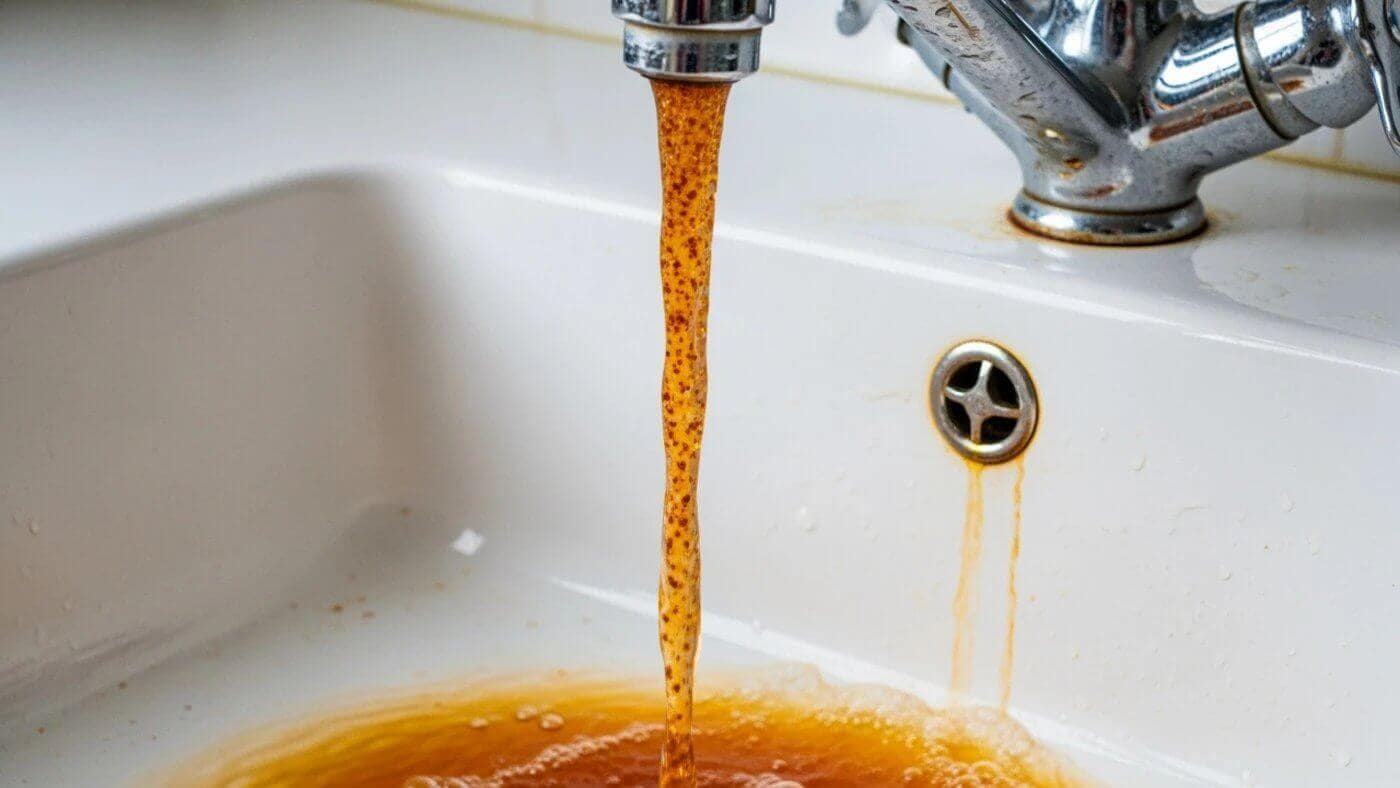
He has done this because the water out of his tap runs the color of a medium-roast coffee. It stains his clothes in the wash. It leaves the sink smelling of rust and rot. He cannot brush his teeth with it. He cannot cook with it. He cannot hand a glass of it to anyone. He said ...
“I can’t recall the number of times I’ve driven to Vicksburg and rented a motel room just to take a shower. Imagine bathing or showering or brushing your teeth in such filth.”Tallulah is a city of 6,000 people in northeastern Louisiana that peaked, at over 11,000 residents, in 1980. As it shrank, it did what many shrinking American towns have done: it scraped. Tallulah bought its water infrastructure system from a private company to generate revenue when other revenue disappeared. For a while, the water bill floated the rest of the city budget. Then the pipes got older. The customer base got smaller. Maintenance was deferred, then deferred again, then deferred past the point where deferral had any meaning. The water ran brown. The school superintendent started canceling in-person classes because the toilets didn’t work. The state eventually issued an emergency order and brought in a private company to run the system. Bills nearly doubled. Some areas got cleaner water. Some areas are still brown.
Donald Wood, who pays more now than he ever paid before, says he does not want the city to run the water infrastructure system again. He has given up on the idea of public water, in the same way that a person gives up on a system that has failed them badly enough, long enough, that the failure starts to feel like the system itself.
This is the moment that water privatization corporations have been waiting for.
The Reckoning in the Pipes
America’s water infrastructure was built mostly in the 1970s and 1980s. The pipes beneath most American cities and towns are between 50 and 100 years old. Purification plants, pumps, underground mains, sewage-processing facilities, the full apparatus of the water infrastructure system is approaching, or past, its useful service life. The American Society of Civil Engineers issues a periodic report card on national infrastructure: in 2025, drinking water earned a C-, wastewater earned a D+, and stormwater tied for the lowest grade of any category at D. These grades have not materially improved since 2021, despite a $69 billion infusion from the 2021 Infrastructure Investment and Jobs Act.
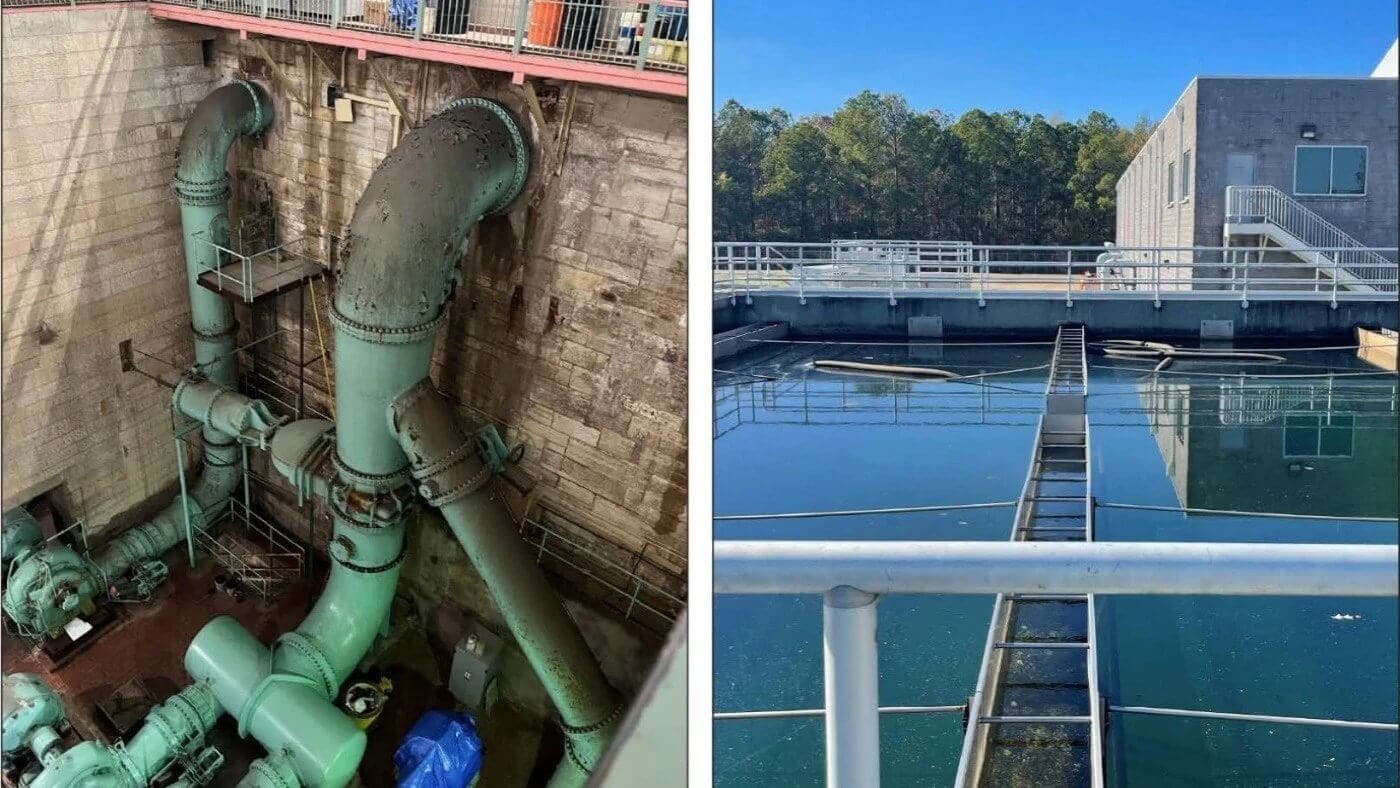 Aging Water Infrastructure In St Louis MO and Jackson MS / Image Credit Pycril
 The U.S. loses the equivalent of more than 50 million Olympic swimming pools of water every single year to leaking pipes — water that is treated, pressurized, and sent through the system only to disappear before it reaches anyone.
The numbers behind the failure are staggering and specific. America’s drinking water systems require an estimated $1.7 trillion over the next ten years to meet current and future needs. Anticipated investment covers barely $655 billion of that. The gap — more than $1 trillion — is not theoretical. It is the number that explains Donald Wood’s brown tap, the school superintendent’s virtual days, and the $200 monthly water bills in a town where many residents are already poor.
But the gap did not create itself. It was built, decision by decision, across four decades of federal retreat. In 1981, the federal government provided more than $25 billion in capital investment for water infrastructure — nearly half of all water spending in the country. Today, that federal share has fallen to approximately 4%. The burden shifted to states and municipalities — and then, as state budgets tightened, to municipalities alone. Small towns with shrinking tax bases and aging systems were left holding a bill they could not pay, for pipes they could not fix, with expertise they could not retain. The water sector faces what researchers call a “silver tsunami”, an entire generation of experienced operators retiring, with too few younger professionals entering the field to replace them. Cotton Plant, Arkansas — population 700, on a boil order since last year — cannot find a qualified water operator willing to work there. It is not alone.
Speaking on Tallulah's aging water infrastructure system, Mayor Yvonne Lewis, Interim Mayor, Tallulah, Louisiana said ...
“Not very detailed maintenance, aging infrastructure, changes in personnel. … It really came to a point where the water system was just out of control. It was just the ugliest time.”Lewis’s words carry the particular exhaustion of a local official trying to manage a structural crisis with local tools. What happened in Tallulah was not primarily a failure of local governance, though governance failures contributed. It was the downstream consequence of four decades of federal disinvestment arriving, all at once, in a town too small to absorb it.
The Predatory Logic of Privatization
Into this crisis, at exactly this moment, comes an offer.
Take for instance- the small village of Housatonic, MA. This small New England village, is on the tip of the of water privatization / aging water Infrastructure spear is served by the Housatonic Water Works Company (HWWC) - a small, privately owned public utility that provides drinking water to about 850 customers (around 1,400 residents) in the village of Housatonic, located within Great Barrington, Massachusetts, as well as parts of neighboring Stockbridge and West Stockbridge. Originally established in 1897, the company has been owned by the Mercer family since 1984.
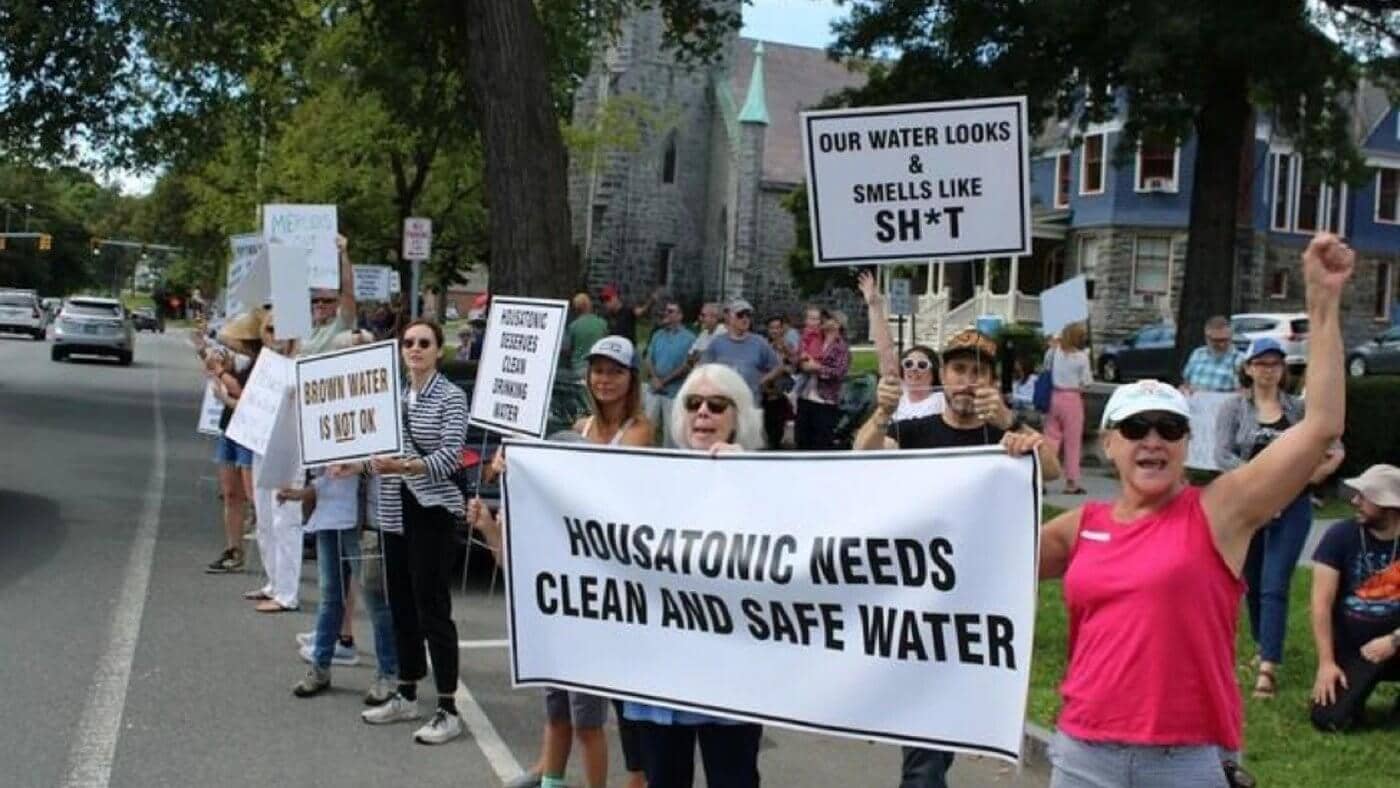 Water loving Berkshire county residents Great Barrington, Housatonic and Stockbridge demanding H2O at Great Barrington Town Hall. / Image Credits Shaw Israel Izikson, Executive Editor, Berkshire Edge.
The ongoing Housatonic Water Works crisis is the direct result of crumbling physical infrastructure, mismanaged operations, and a legacy of empty regulatory promises.
The company estimates it requires roughly $4.5 million in capital improvements and deferred maintenance to adequately upgrade its system, remove manganese, and address the severe water discoloration issues. The issues facing tiny Housatonic, MA are endemic of towns, villages and cities - all around the greatest country in the world. Making Housatonic, MA and Top 10 Town of Great Barrington, MA on the tip of the the proverbial American water spear. Maybe water lovers will lead the water upgrade - the new h2o american revolution - where we can be responsible for the Life part of ... life, liberty and pursuit of happiness.
Nearly 73 million Americans already rely on private companies for drinking and wastewater service, a figure that has grown substantially in the past five years. Private water companies have been extraordinarily effective at positioning their capital as a solution to the infrastructure crisis. To a mayor facing a $400 million repair tab and a city council with no path to raise that money, a corporate buyer offering cash for the water infrastructure system can look like a rescue.
Currently, 15 states have passed legislation, often called “fair market value” laws specifically designed to make water utility sales more financially attractive, by allowing sellers to value systems at inflated figures that buyers then recoup through rate increases.
According to Mary Grant, Water Policy Director, Food & Water Watch ...
“The key concern with the privatization of water is that loss of local control over the projects. Companies may be offering large sums of money to entice local officials to sell assets, but that's not free money. That’s just a debt that your constituents are going to have to pay through their water bills.”The pattern after privatization is well documented: rates rise, often dramatically. A Pennsylvania court ruled in 2024 that a state utility commission should not have approved the sale of a municipal sewer system because the deal could have led to rates doubling. In Tallulah, where a private company was brought in under emergency state order rather than sold outright, bills have nearly doubled anyway, and Fannie Augusta King, a community organizer who has spent years fighting to improve Tallulah’s water, has watched her parents’ monthly bill climb past $200. Her aunt’s water, on the other side of town, still runs brown. The bills went up. The solution did not arrive equally.
This is the predatory logic of the infrastructure crisis: the same forces that benefit from the underfunding of public systems are positioned to profit from their failure. And the people most likely to accept an extractive deal are the people who have been failed the longest.
The Communities That Said No
In November 2024, Gloucester Township, New Jersey held a water referendum.
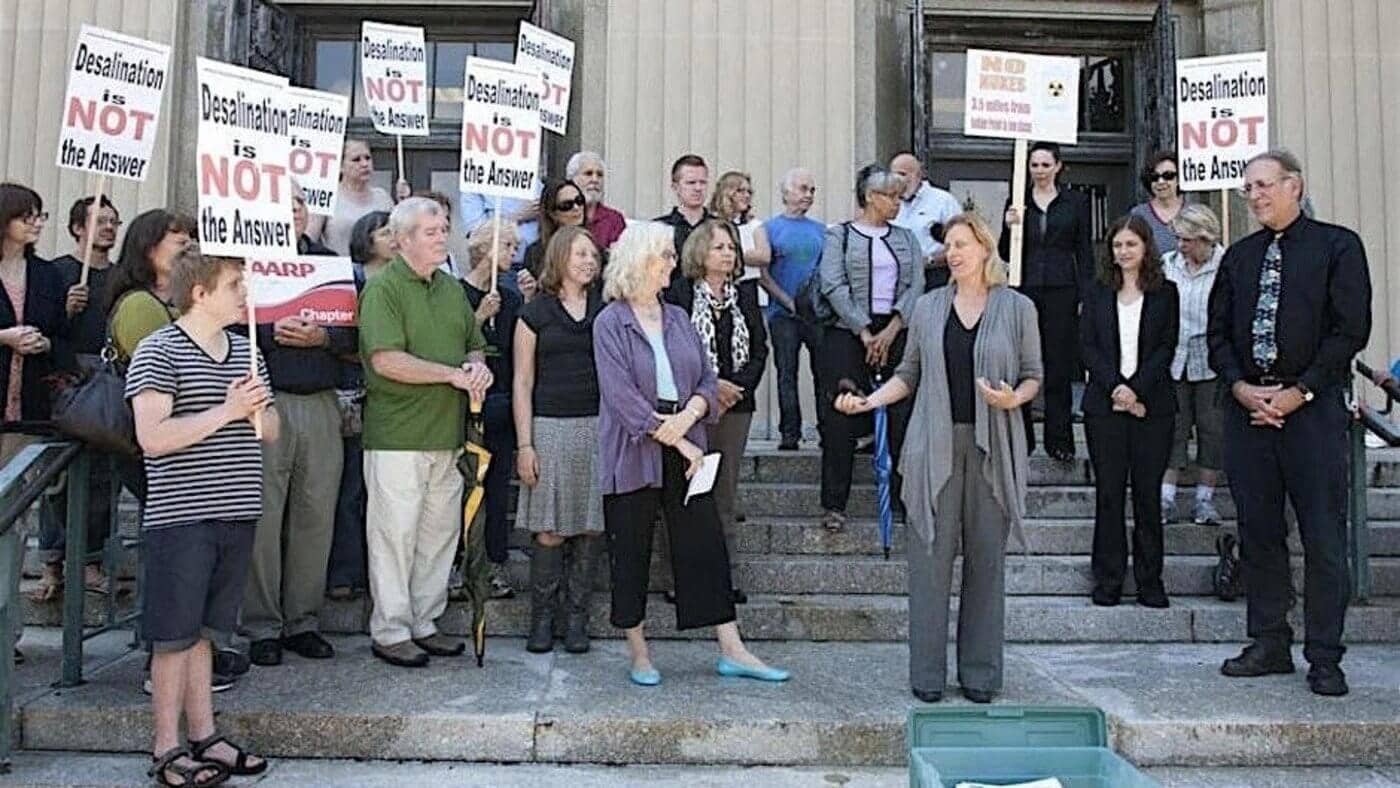 Rockland Water Coalition 2024 Press Conference Fighting Suez Desalination Plant / Image Credit Rockland Water Coalition
The New Jersey American Water mounted a campaign of over $1 million to convince residents to sell their public water and sewer system. People thought it was a bad h2o deal.
Against that campaign, a grassroots coalition of residents, union workers, and Girl Scout troops organized neighborhood by neighborhood to explain what the sale would mean and what alternatives existed. Eighty-one percent of Gloucester Township voters rejected the sale. Buh, bye.
The corporate campaign spent more than $1 million. The community campaign spent a fraction of that. People power, in sufficient concentration, beat the money.
Gloucester Township did not appear in national headlines.
Neither did the Rockland Water Coalition’s decade-long fight against a Suez desalination plant in New York, a fight that united lawyers, scientists, educators, planners, and community organizers in what became one of the most sophisticated grassroots water campaigns in recent memory.
Peggy Kurtz, Co-founder, Rockland Water Coalition said ...
“It was immediately apparent that this wasn’t going to be something one group alone could fight.”Kurtz’s coalition won. They stopped the plant. They then kept organizing, fighting rate hikes, pushing for infrastructure repair over new construction, and, now, fighting PFAS contamination as the Trump administration rolls back federal standards. The same coalition that stopped a desalination plant a decade ago is now one of the most effective water advocacy organizations in the Northeast. The infrastructure fight and the contamination fight are the same fight, pursued by the same people, with the same tools.
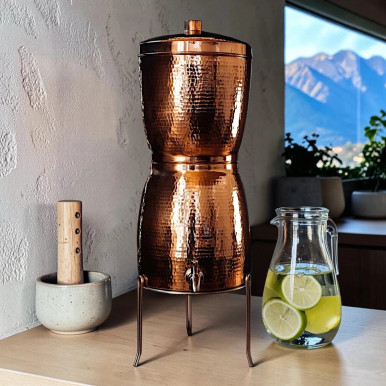
Sertodo Sana Vida Ayurvedic Copper Gravity Water Filter System Essentials Kit
$904.00
Sana Vida = Healthy Life. Celebrating a healthy life is the fundamental purpose of our elegant and world class Sertodo Sana Vida Ayurvedic Copper Gravity… read more
In January 2025, the Navajo Nation secured a landmark water rights settlement, 81,500 acre-feet per year from the Colorado River, after generations of denial, in what advocates called one of the most significant Indigenous water rights victories in American history.
In Pittsburgh, the Our Water Campaign stopped further privatization of the Pittsburgh Water and Sewer Authority after years of organizing that forced democratic accountability into a system that had been slipping toward corporate control. In Baltimore, community organizers stopped a Veolia contract that would have handed a private corporation control of one of the country’s major urban water infrastructure systems.
These wins share a structure: they require time, expertise, coalition-building across ideological lines, and a willingness to show up to meetings, to hearings, to courtrooms, to ballot boxes. They are almost never covered nationally. And their invisibility serves the corporations that depend on communities not knowing that resistance is possible, let alone that it works.
Top 6 US Locales With Underfunded Water Infrastructure
- Jackson, Mississippi - The Water Crisis & Status: Decades of neglect caused a total system collapse in 2022, but a federal manager achieved compliance by 2025. However, a 12% rate hike was enacted in early 2026 to cover deficits, and a bitter state-versus-city governance battle looms before an October 2026 deadline.
- Tallulah, Louisiana - The Water Crisis & Status: Population loss halved the tax base, leaving residents with black tap water and $200 bills; consequently, the governor renewed a State of Emergency in April 2026 as health officials warn the system remains at constant risk under state-ordered private control.
- Prichard, Alabama - The Water Crisis & Status: The city loses 60% of its water and defaulted on a $55 million loan, leaving it in a textbook "downward spiral" where it currently remains under a court receiver with no viable path to fund $400 million in repairs.
- Richmond, Virginia - The Water Crisis & Status: The city ignored a 2022 EPA audit until a January 2025 collapse left 230,000 residents without water; today, the city is under a state corrective plan, needs $63 million in extra upgrades, and has suffered two additional boil-water advisories.
- Housatonic, Massachusetts - The Crisis & Status: For years, this village has struggled with severely tainted, dark tap water managed by a private, debt-strained utility that lacked access to low-cost municipal infrastructure financing. To resolve the crisis, Great Barrington formally petitioned the state Supreme Court in June 2026 to step in and help determine a fair value for a public takeover.
- Holyoke, Massachusetts - The Crisis & Status: Relying on 19th-century sewers that dump sewage into the Connecticut River, the city is currently executing a $35 million federal consent decree through 2035, though funding it via rate hikes heavily strains local taxpayers.
The Price of Letting It Fail
Donald Wood is still in Tallulah. His water is better now than it was — cleaner, more reliable, though the bills are higher and some neighborhoods still run brown. He has said, publicly, that he does not want the city government to run the water again. He would rather pay a private company. That is a rational response from a man who drove to Vicksburg for showers for years.
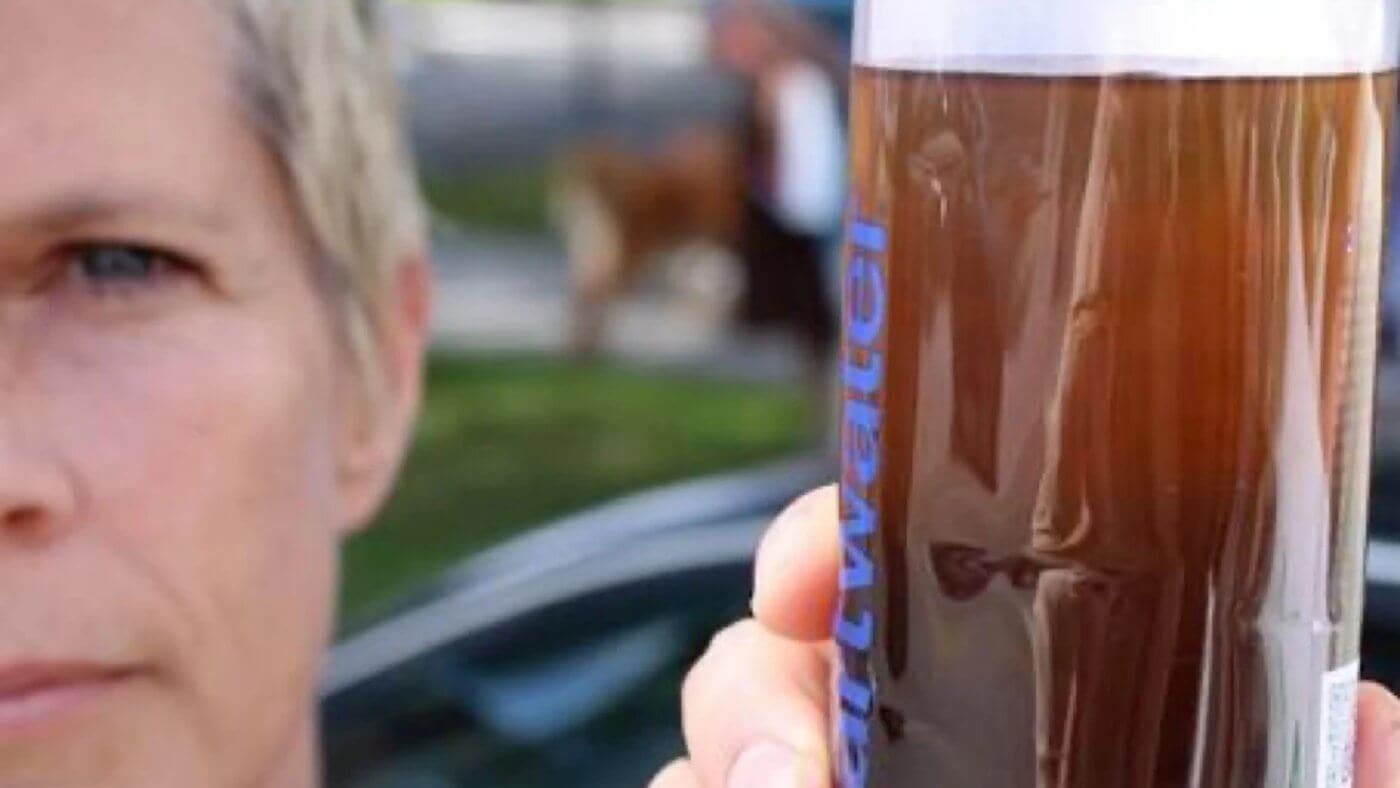 Water loving Berkshire county resident plays show and tell with his water at Great Barrington Town Hall. / Image Credit Shaw Israel Izikson, Executive Editor, Berkshire Edge.
What Donald Wood’s position illustrates is not the failure of public water as a concept. It is the failure of public water in Tallulah, specifically, a failure with specific causes: federal disinvestment across four decades, a shrinking tax base, deferred maintenance, and an absence of the technical and financial support that a town of 6,000 people cannot generate on its own. The Tallulah that failed Donald Wood is not what public water looks like when it is funded. It is what public water looks like when it is abandoned.
Donald Wood and friends were impacted by the unseen tax of a faulty water infrastructure system, having to spend money on a water filter system, Mr Wood explained ...
“Several people here, when the water became so bad, so frequently, bought very expensive filters that they would put outside their house and to filter the yuck out of the water.”The cost of letting systems fail, Pew Charitable Trusts documents, is invariably greater than the cost of maintenance would have been. San Diego’s failing storm water infrastructure, which caused a 2024 flash flood that destroyed homes and created a sinkhole, carries a deferred maintenance backlog of at least $2 billion. Prichard, Alabama’s total repair cost is estimated at over $400 million. The state of Louisiana spent $11 million rebuilding a small town’s water system that would have cost far less to maintain. The math of deferred maintenence always runs the same direction: the longer you wait, the more it costs, and the more desperate the community becomes — and the more attractive privatization looks.
Average American water and sewer bills have increased 54% since 2012, more than twice the rate of inflation — as utilities struggle to catch up on deferred repairs. The people paying those bills are increasingly the people who can least afford them.
What Staying Public Requires
The answer to the infrastructure crisis is not mysterious. It requires money — more money than individual small towns can generate, which means it requires sustained federal and state investment at a scale the country has not seen since the 1970s.
Texas has committed $1 billion annually for water infrastructure projects for the next 20 years. California is investing in projects addressing flooding, drought, and water supply resilience. The 2021 Infrastructure Investment and Jobs Act provided $69 billion for water, significant, but a fraction of actual need.
What is also required, and what the Gloucester Township and Rockland County examples demonstrate, is organized civic resistance to the capture of water systems by corporations who are skilled at presenting extraction as rescue. The Clean Water SRF Parity Act of 2025, which would allow large for-profit corporations to access funding streams designed for local public systems, is a federal-level version of the same move. More than 100 organizations signed letters urging its rejection.
Nickie Sekera, a co-founder of Community Water Justice, a network of communities opposed to privatization said ...
“Elite capture of our water commons is the final frontier in the commodification of all living things and should be resisted as though our lives depend upon the water we drink.”The infrastructure crisis and the privatization push are not separate problems. They are the same problem in two phases: first, defund public systems until they fail; then, present corporate control as the only solution.
Communities that understand water system failure, that have seen it play out in Pittsburgh, PA; in Jackson, MS; in Tallulah, LA are the ones most capable of bringing about a better outcome.
Donald Wood is not wrong to distrust the Tallulah city government that failed him. But the answer to his distrust is not the permanent transfer of his water to a corporation whose interest is profit. The answer is the kind of investment, oversight, and technical support that would have prevented the failure in the first place, and that communities across the country are now demanding, with growing sophistication and growing success, from the water systems that were supposed to serve them.
The pipe beneath your feet is failing. The question is not whether it will be fixed. It will have to be fixed. The question is who will pay for it, and who will own it when the bill is settled.
A Deeper Look At The Issue - Video
This short video exposes the corporate takeover of public water and sewer systems, tracing how investor-owned utilities exploit legislation to double and triple household bills. Spotlighting the grassroots resistance in Pennsylvania, it documents how an unlikely coalition of communities is fighting back to protect a vital resource..
Related Articles
The Miracle of Water Birth: A Gentle, Natural Approach to Childbirth
The tub was just a tub, white fiberglass, warm water, a handheld showerhead propped against the rim....
America’s WATER UPRISING
Emily Marpe was standing in her driveway in Petersburgh, New York, when the health department called. She...
Reversing The Global Water Crisis: The 4 Pillar Plan
In the West Plains community, just west of Spokane in Eastern Washington state, Marcie Zambryski came...